

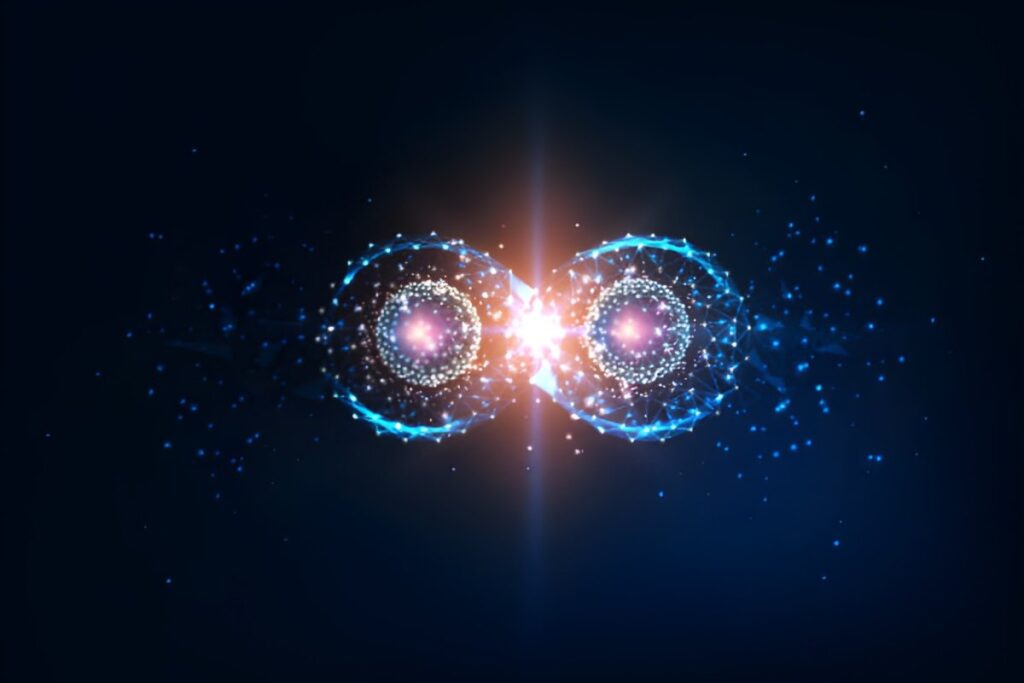
Quantum entanglement is one of those concepts that literally knocks the roof down and sounds like science fiction, but it is a pretty real phenomenon in physics. This is the thing that keeps the particles attached, regardless of the distance between them. As soon as one particle changes, another, even many kilometres away, also changes. Unsettling, right? Einstein himself could not explain it and called it “disturbing action at a distance”.
So how does this strange, but ultimately feasible, concept define the future of computing, communications, and innovation in general?
What Is Quantum Entanglement?
Quantum entanglement, in general terms, refers to the coupling of subatomic particles that physical theories cannot explain. What demons are we talking about? Consider the example of two coins thrown in opposite directions in the universe, and whenever one lands on an eagle, the other also instantly lands on an eagle, without signs. No delays. Just an instant connection.
According to quantum mechanics, particles such as photons or electrons can correlate so profoundly that their states become one. As a result, one particle’s measurement automatically implies another’s measurement. What is even stranger is that communication between them occurs at a speed that exceeds that of light. Scientists do not know the reason, but they know it works, which is enough to apply this principle.
The Impact of Quantum Entanglement on the Future of Computing
Qubits in quantum computers can simultaneously store two values: 0 and 1. The situation changes radically when we talk about entangled quantum bits. These can exchange information in ways inaccessible to traditional machines if intertwined. This is because the amount of complex mathematical problems that these have to solve, which a conventional processor would take tens of thousands of years, can be solved in seconds.
It is possible to imagine that problems such as encryption, optimisation, and drug development are solved overnight. Obviously, the incentives provided by big tech companies and the scientific research communities have generated fierce competition in the search for an ideal quantum processor that is not only relatively stable, but also fast and accurate thanks to quantum entanglement.
Still, this is just the beginning. Quantum computers are fragile and require extremely low temperatures to operate. But progress is relentless. With each new advancement, we move closer to the computer revolution.
Quantum Entanglement and Communication Security
Imagine a world where even the most advanced cybercriminals cannot hack your online data. Herein lies the potential of quantum entanglement in the field of communications.
Quantum key distribution (QKD) uses entangled particles to create secure communication channels. If someone tries to intercepting the message, the state of the particles will change, instantly alerting both parties to the tampering. It’s like a self-destructing code that knows when it’s being watched.
China and several European countries have already conducted tests of satellite communication channels with quantum shielding. They could become the basis of a future global network, a kind of “quantum internet”. It sounds futuristic, but it is already being implemented in labs worldwide.
Real-World Applications and What’s Next
Beyond computing and security, the use of interweaving can completely transform the field of medical imaging, navigation and even energy. For example, quantum sensors could detect diseases early by accurately analysing molecular changes.
However, the issue of scalability remains crucial. It isn’t easy to create stable intertwined systems, for example, outdoors, except in specially equipped rooms. However, this problem does not deter the spirit of invention. These limitation will likely be overcome over time, and new opportunities will open up for industries we had not even imagined.
The Bigger Picture
Quantum entanglement forces us to rethink the idea of ”connection”, not only from a physical, but also a philosophical perspective. It points out that the universe might be a complex, interconnected network, far more complicated than we ever imagined. And maybe that’s the most important thing.
We are approaching an era where science is intertwined with mystery. Where a sense of wonder replaces rules, a future based on quantum technologies will be faster, wiser and fundamentally different.
Final Thoughts
Quantum entanglement is one of the strangest phenomen in physics and the root of the future technological revolution.
It expands the boundaries of the achievable: from virtually indecipherable data protection to computing power unattainable to the human mind.
The next stage is no longer beyond the mountains but inextricably linked to the present.