

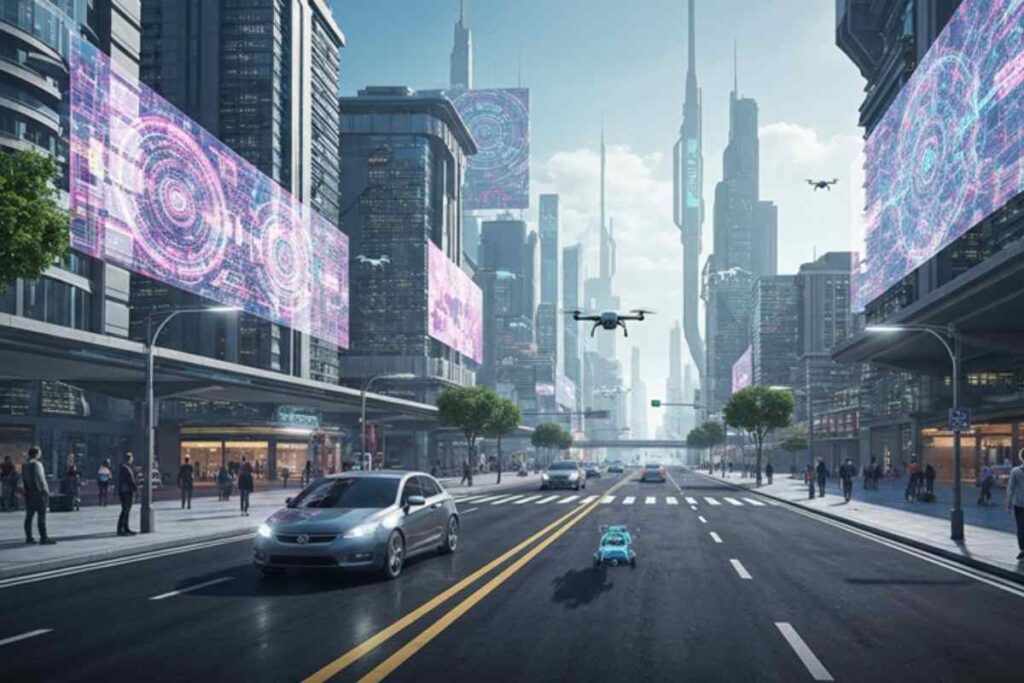
The world of Latest Technologies is changing fast. New ideas and tools show up all the time. A significant change in one part can start new things in another. These tech trends affect each other and the real world. Knowing about the latest technology trends is not just for tech experts now. It is crucial for anyone wanting to get ahead in work or business. Do you want to see what will happen soon? This guide will show you the top 10 tech trends shaping our world in 2025.
The Top 10 Latest Technologies Shaping 2025
So, what are the ten most talked about new technologies that people think will change the world in 2025? Many of these have to do with artificial intelligence and better ways to connect. These new ideas will have a significant impact on entire industries. Tech companies now spend a lot of money on machine learning, building smarter data centers, and finding better supply chain work methods. These changes will help us move forward in big ways and simplify life for many people.
These new ideas are not just something you read about in theory. They are being used in real life and will change how we live and work. As we go through each of these, you will see how these technologies help to make the world more intelligent and connected for all of us.
1. Generative and Agentic Artificial Intelligence
You probably know about generative AI. This is a new kind of technology that is changing the way we create content. It makes use of innovative computer programs. You can produce text, pictures, and even lifelike simulations with these. The good thing about it is that now, tools for content creation are easier to use. They also give you more ways to get things done than ever before.
Agentic AI is a part of artificial intelligence. It works with little or no help from people. It is different from other types of AI that follow set rules. Agentic AI can think, make plans, and choose what to do independently. It usages machine learning and natural language processing to work by itself.
Picture virtual assistants that do more than answer what you say. They help handle your daily plans, messages, and other complex tasks. The tech trends in 2025 show that these tools are not just doing small jobs for you. They are acting like real digital partners. The new way helps people be more productive. This is something that has not been seen much in the past years. What is different now is that these assistants can work on their own. This autonomy sets them apart from older virtual assistants.
2. Quantum Computing Breakthroughs
Quantum computing is a big step ahead of our current computers. Regular computers use bits. A bit can be a zero or a 1. But quantum computers use qubits. A qubit can remain 0, 1, or both simultaneously. This is called superposition. Because of this, quantum computers can work with a lot of information all at once.
Quantum computers can solve problems that are way too hard for older machines. These older machines would need millions of years to work out the same things. For example, quantum algorithms can help drug discovery by letting us model molecules faster. They can also look at climate change and accurately show us what is happening. This is a significant change from how old computers worked, as they used to process things individually.
Quantum computers are growing fast, and the field is getting stronger yearly. This technology is starting to be something that more people can get. It looks like it will change a lot for all of us, from finance to healthcare. A new era is coming for how we solve big problems. Right now, we are only starting to know what this might mean.
Let’s talk about the different technologies we will see in 2025. When we talk about quantum computers, the main thing is how they use the strange rules of quantum mechanics. That’s what helps them do things no normal computer can do. This new era of technology could help us more than we can guess right now.
3. Next-Generation Connectivity: 6G & Advanced Networks
While 5G is still coming out, people in tech are already talking about 6G and other new networks. The new type of connection should be even faster, cover more places, and have very low latency. This means there will be almost no wait time when you send and get information.
What does this mean for you? These new networks help power significant changes like the Internet of Things (IoT). They let IoT devices in smart cities talk to each other immediately. This makes it possible to manage traffic, improve energy use, and keep people safe in real time.
This strong connection will bring new ideas that surpass what you see now. For businesses, this is a big deal. It supports everything from cars that drive themselves to deep augmented reality. It helps us get to a world where everything is really connected.
4. AI-Driven Cybersecurity Innovations
As life gets more digital, we need strong cybersecurity now more than ever. There are cybercriminals out there using innovative tools to attack systems. It means our protection has to be even smarter. This is the role of artificial intelligence. It helps build new and better ways to keep information safe.
AI and machine learning tools can go through a lot of data from many data sources simultaneously and in real time. They help spot strange patterns and warn about possible dangers. This way, organizations can find and stop attacks early. It helps them act fast before any big problems happen.
Financial institutions and government agencies now use strong security systems to keep important information safe. They use different layers to protect data. AI-driven cybersecurity can find threats without people having to do it. This helps companies stay ahead of hackers, which is very important because there are many risks right now. But are there risks or problems with the best new technology in 2025? In cybersecurity, the biggest problem is that attackers can also use AI. So, they can use the same new tools to try to get past these defenses.
5. Metaverse & Spatial Computing Applications
The metaverse and spatial computing bring the real and digital worlds closer. Now, it is not just about looking at a screen. You can use gestures, voice, or eyes to control digital content. This lets you get into the experience in a whole new way. Things we once saw only in science fiction now happen in real life.
Think of extended reality (XR) as a big name for different digital worlds. It covers things like virtual reality (VR), augmented reality (AR), and mixed reality (MR). In the metaverse, you can be in a space that is all digital, thanks to virtual reality. At the same time, spatial computing lets digital information show up right on top of your everyday life.
These technologies are used for much more than games. In stores, people can try on clothes with virtual try-ons. Architects now look at buildings in 3D before they build them. Surgeons use AR to make their work more careful and safe. The new technologies in 2025 will change the way we live every day. They will also shape the way we talk to each other and use information. This will have a significant impact on our world.
6. Edge Computing for Real-Time Data Processing
Cloud computing has changed how we do things, but has some limits. One of the main problems is with speed. Edge computing helps solve this by handling data processing near the generated data. By doing this, the data does not have to travel to a cloud far away. This way, everything works faster, and you can use real-time data processing. Edge computing uses a different approach from the old cloud computing because it does not keep everything in one place. This new way is perfect for speed and for handling data right when you need it.
Why does this matter? There must be instant decisions in things like autonomous cars, smart factories, and IoT systems. Edge computing helps with this. It lets you look at data right where it is, like on a factory floor or in a smart camera. Experts predict that by 2025, more than half of all business data will be worked on at the edge.
This shift does not eliminate cloud computing, but adds to it. Companies can use both together. A hybrid model lets them use the scalability of cloud computing along with the speed and efficiency of edge computing. This helps make things work faster and more reliably. Would you like to know how all the new technologies of 2025 work? Edge computing works by moving computation and data storage closer to where the data is created.
7. Blockchain Beyond Cryptocurrency
When you hear the word “blockchain,” you might think about Bitcoin or other types of digital money. But this technology can do much more than that. Blockchain works as a record that does not belong to just one person or business. It lets many people see and check the record. This makes it great for areas with safe and clear deals that anyone can look at and trust.
A good example of this is supply chain management. Blockchain lets you follow a product from the factory to the buyer. It checks if the product is real and prevents fraud from happening during each step. This precise tracking makes people feel safe about money moves, inventory lists, and when things get delivered. The blockchain market is set to go from $20 billion in 2024 to $248 billion by 2029.
There are risks and challenges linked to the top technologies in 2025. One thing to watch out for in blockchain is its energy consumption, as some applications use a lot of power. Still, many industries, such as healthcare and government, are looking at how it can make data centers safer and product development more transparent. It shows that blockchain is just starting to show all of its value.
8. Advanced Robotics & Automation
Robotics and automation are growing fast. Now, machines can do complex tasks with little or no help from people. These robots are not just on the assembly line anymore. Now, they work next to people in many fields as collaborative robots, often called “cobots.”
In manufacturing, robots take care of jobs that need a lot of precision. They also help with quality control to make sure things are made well. In logistics, robots help by doing routine tasks. These tasks include sorting and packing items. The global robotics market will likely reach $210 billion in 2025. There will be more than 3.5 million industrial robots working all over the world by then. This growth gives people new ways to be efficient and develop new ideas.
People worry that robots may take jobs. But robotics is also making new jobs. In 2025, some skills will be needed because of these new technologies. You will see openings for AI programming, robotics maintenance, and automation programming. As businesses bring these intelligent machines to their offices, they will want people who know how to work with them.
9. Sustainable & Green Technologies
People are talking more about climate change now. Because of this, many in the tech industry want to help the Earth. Green tech works to develop new ideas that use less energy and reduce carbon emissions. It is about people and companies being good to the planet. This green tech movement is not just for a few. All businesses need to think about how to lower energy consumption and help with climate change.
Tech giants are putt a lot of money into renewable energy for their data centers. Smart cities now use AI tools to help with energy use and reduce waste. If companies use more sustainable IT, the world could see carbon emissions decrease by 30% by 2030. These efforts show how renewable energy, smart cities, and better ways to run data centers can help us all.
The move to energy efficiency is now one of the most important technology trends for businesses. Companies that use green tech help protect the planet. They also get ahead of others as more people and groups want eco-friendly working methods.
10. Biotechnology & Personalized Medicine
Biotechnology is changing healthcare in a big way. It uses biological systems to help make new products and treatments. This field brings together biology, genetics, AI, and bioengineering—all of which work to solve some of the world’s most complicated health problems. One big trend in this area is personalized medicine.
Personalized medicine does not use a single treatment for everyone. It looks at each person’s genetic makeup, lifestyle, and where they live. The goal is to pick the best treatment for each person. This way, treatments work better and cause fewer side effects. It is changing how doctors treat cancer. Now, medicine can focus on notable genetic changes in a person.
Biotechnology is helping us do more, like finding new drugs and creating gene treatments. The mRNA vaccines for COVID-19 are one good example. This field is making things possible that we could not do before.
The tech trends for 2025 are not the same as last year. Last year, the focus was broad, covering many things. Now, the focus is on hyper-personalization. The aim is to use our own biology to get better health results.
How Do These Technologies Work?

It can feel hard to learn how these new technologies work. But they all have standard rules at their base. A lot of them use advanced algorithms to process information in new ways. These rely on less human intervention now. You can see their practical applications in our daily lives.
From AI that learns from data to quantum computers that do millions of things simultaneously, these systems are built to take on complex tasks with lots of pieces. Now, we will look into some big ideas behind these new ways of doing things and how people use them.
Key Concepts Behind Each Technology
Many of these technologies are based on ideas people have worked on for a long time. Machine learning is one of the chief tools used in AI. It helps systems learn from data, so you do not have to tell them what to do step by step. Neuromorphic computing goes beyond that, making chips that act like the human brain.
These ideas are now used in new and strong ways. Quantum computing uses superposition and entanglement, giving it high-speed processing power. Edge computing is about processing data close to the source to get results immediately.
Here are some of the main ideas behind 2025’s tech trends:
- Parallel Processing: Quantum computers make it possible to simultaneously work on many parts of a problem.
- Decentralization: Edge computing and blockchain spread out data. This helps to keep data safer and makes things work faster.
- Neural Networks: These are made to work in a way that is a lot like the brain. They move deep learning forward and also help in neuromorphic computing.
- Real-Time Data Processing: Edge computing and 6G let people look at data immediately and help them make quick choices.
- Transparent Ledgers: Blockchain gives a record that cannot be changed. This is good for supply chain and management, among many other things.
How Emerging Technologies Interact and Integrate
None of these tech trends works alone. They get stronger when they mix and work together. AI integration shows how this works. It makes things better, like cybersecurity and biotechnology. Think of these tech trends like blocks that help build a brighter future.
This teamwork leads to new things that one technology alone could not do. For example, smart cities need many parts to work well. They use IoT devices, edge computing, fast networks like 5G or 6G, and AI. In the same way, the metaverse will only work if AI, cloud computing, and network speeds improve.
Here is how some of these technologies work together:
- AI and IoT: Smart devices gather data. AI looks at that data to find helpful information.
- 5G/6G and Edge Computing: Fast networks help process data at the edge, which happens in real-time.
- Blockchain and Supply Chain: A safe ledger keeps track of goods. IoT sensors help manage these goods.
- Cloud and Edge Computing: A mix of cloud and edge computing lets their data processing be central and spread out. This use of both is a significant change from before. Many technologies have not worked together like this in the past few years—they have grown apart.
Advancements in Underlying Science and Engineering
The tech trends 2025 may seem impressive, but they are not magic. They come from many years of work in science and engineering. Things that used to feel like science fiction are real now because of material progress, better ways to solve problems, and a deeper understanding of how complex things work.
For example, how neural networks work has helped the growth of machine learning and AI. Neural networks copy how the human brain is set up. In quantum computers, new quantum algorithms help solve more problems. These key steps in technology are what push new ideas forward.
Engineers are working hard to help save more power. They are making neuromorphic chips that do not use much energy. They are also coming up with renewable energy ideas for data centers. These better ways to build hardware and software get help from many data sources. That is what sets this new change apart from last year. This is why we now see a big jump in how technology moves.
Impact on American Businesses & Society
The latest technologies are about to change American businesses and society significantly. When companies use new things like AI and blockchain, they can see their market value go up and grow. These new tools also help them improve their supply chain and work faster and more easily. This is good for everyone and helps us all move forward together.
These changes will affect how people do their everyday tasks, talk to each other, and get healthcare. In the next few years, there will be significant changes in many industries and in how we live daily. There will be some exciting chances, but there will also be new problems.
Transforming Major Industries in the United States
Many industries in North America are changing because of new technology. The United States stands out, as most companies use AI and machine learning. About 73% of these businesses have started using it one way or another. This has helped grow the market value in critical areas. The annual growth rate in these sectors is also high because of machine learning.
Businesses like manufacturing and finance are now using innovative solutions to stay ahead. These technologies help them not just to make their work better but also to build new ways to do business and find chances to grow. It is not only about changing what is already there. It is about moving into something new. As we look to 2025, you may wonder which industries will gain the most from the latest tech changes. The effects of this move are significant and can be felt in many different fields.
Here are some main fields that are changing in significant ways:
- Manufacturing now uses robots that help with automation and quality control.
- Finance uses AI to find fraud and to trade on its own.
- Healthcare is seeing new things like medicine made for each person, and AI that helps doctors find what’s wrong.
- Transportation has driverless cars and better ways to move things because of AI.
- Security always uses AI to watch out for threats and keep things safe.
Benefits to Everyday Life & Societal Changes
The new technologies in 2025 will change the way we live and work. You will feel these changes in almost every part of your life. These innovations help people do more, take care of boring jobs, and help solve big problems in our world. The aim is to use human capabilities better, making life easier.
Picture virtual assistants that help you plan your day. There are telemedicine platforms that let you get healthcare without leaving home. Smart city infrastructure tries to cut down on traffic and pollution. These technologies make life much easier, save time, and help us live well.
These changes in society will give us many good things:
- Improved Healthcare: Remote work for doctors means they can help patients from anywhere. Personalized medicine makes care better for people.
- Enhanced Safety: AI helps guard people by making cybersecurity smarter. Safer public systems keep communities safe.
- Sustainability: New ideas in climate science and green tech help us deal with environmental problems.
- Greater Convenience: Virtual assistants and voice-activated devices make everyday tasks easier for all of us.
Skills in Demand Due to 2025 Tech Trends
The job market is changing as new technologies grow. In 2025, some skills will be in demand more. People who can make, use, and handle these new tools will get more jobs. Knowing how to work with software development, data processing, and AI will be good for anyone who wants a strong job.
Companies want people who know how to work with big data and help with product development in this new world of technology. You don’t need to have technical skills to do well—problem-solving and being able to adapt matter just as much.
Here are some of the most needed skills for 2025:
- AI and machine learning are now share of our daily lives. These skills help people and businesses work better.
- Cybersecurity and data privacy are paramount today. Your work needs to keep data safe for everyone.
- Cloud and edge computing make sharing, saving, and getting information easier. These tools help you or your team do jobs faster.
- People are working hard on quantum algorithm development. When you learn about this, you can use it in new ways.
- Blockchain and innovative contract programming let people make new systems for money and rule-setting online.
Practical applications and experience in machine learning, edge computing, and these fields can help you have a good and strong career over time.
Leading Companies & Innovators to Watch
Who are the top tech companies that will shape new technologies in 2025? The long-time leaders in the tech industry are making significant advances. There are also fresh startups and people with global reach who are changing the game. These new players help bring future ideas to life. The push from these innovators makes the tech world move forward fast.
These groups are leading the way in making strong AI models and working on new robots. If you follow what they do, you can get good ideas about where technology will go.
Top U.S. Companies Driving Tech Advancements
Many top tech companies in the United States are putting a lot of money into new ideas. This is helping to shape what the future will be like in 2025. Big names like Google, Microsoft, and IBM are leading the way. They are working to improve artificial intelligence, quantum computing, and cloud computing. These tech companies are growing fast and changing how we use technology.
These companies do not work in just one area. They are building large systems that bring many new technologies together. For example, Amazon is now a leader in online shopping. It also offers cloud services and works with AI. Intel is working on the latest neuromorphic chips. These chips help with faster and better processing.
Here are some of the key players to watch:
- Microsoft: A top name in responsible AI. The company leads in cloud computing with Azure. They also make mixed reality products like HoloLens.
- Google: This company is strong in AI research. They push work in quantum computing. You also see their technology in self-driving cars from Waymo.
- IBM: They are early builders of quantum computers. The business sets rules for AI through Watson.
- NVIDIA: Their advanced GPUs and software drive AI and robotics.
- Amazon: A big player in AI. They also lead cloud computing with AWS and improve logistics through automation.
Global Innovators and Influencers in 2025
Innovation is happening in the United States and in other countries, too. Companies worldwide and global influencers are adding to the latest technology trends. These groups bring different ideas and help push competition and teamwork all over the globe. This allows AI to get into more areas faster. It also helps to raise the market value of new tech.
In Asia and Europe, the companies are working on new things like 5G, 6G, robotics, and better ways to use good technology for the planet. Their work helps make the global tech ecosystem stronger. This is good because the new ideas can spread and help people everywhere.
Here are some global innovators you should watch for:
- DeepMind (UK): DeepMind is now with Google. The team has taken significant steps in AI, such as AlphaFold.
- International firms in Asia: These companies are at the forefront of robotics and next-gen network tech.
- European research institutions: The places in Europe contribute a lot to quantum computing and AI ethics.
Startups Leading Disruption in Emerging Technologies
Big companies have a lot of money and people. But it is often startups that bring real change. These small and fast-moving companies push us into a new era of technology. They do this by working on special problems or looking at old industries differently. Startups use fresh ideas to shake things up.
We see many significant changes today, like collaborative robots and new green tech ideas, that started at a startup. These businesses are not scared to try something new. They help push the boundaries and play an essential role in innovation.
Here are some types of startups leading the way:
- Agentic AI Startups: These companies make autonomous agents that can handle hard work like writing code and solving complex tasks. They use agentic AI to do jobs that need innovative thinking without help from people.
- Quantum Computing Companies: They work to build new hardware and software using quantum computing. With this technology, there can be significant changes in solving problems and making things faster.
- Biotech Innovators: Some groups use CRISPR with AI to speed up drug discovery. This helps them find answers to health needs in less time.
- Green Tech Pioneers: They are making new ways to support renewable energy and capture carbon. The work in green tech gives hope for better ways to protect the Earth.
- XR and Metaverse Creators: These people make fresh digital worlds where people can feel like they are inside. They work to change the way we think about digital spaces.
Challenges, Risks & Opportunities of 2025 Technologies
Significant changes often give us new things to think about. The latest technologies in 2025 offer many good things for people, but also have significant problems and risks. We must consider what is right, what happens if people lose their jobs, and why some might not use these new tools. Finding ways to make these changes work for all of us is essential.
These challenges bring new job options and more investment opportunities for people who can move through them. To do well in this new world of technology, you need to know the risks and the good things that come with it.
Potential Risks and Ethical Considerations
Yes, there are risks and challenges when you use the latest tech. As things like AI become more able to work independently, people start to ask tough questions. Who is responsible if something goes wrong? How do you deal with bias? When should there be human intervention? These are all essential questions.
It is vital to make sure that any new system is fair. It should also be transparent and open, and it should be safe for people to use.
Another big worry is what it does to the environment. The substantial data centers and the power needed for AI and quantum computing use much energy. Because of this, people feel it is urgent to focus on sustainable ways to lower carbon emissions.
Key risks to consider include:
- Data Privacy: You need to ensure the data sources stay safe to avoid breaches.
- Algorithmic Bias: AI systems must be built not to make bad or unfair choices about people.
- Energy Consumption: The use of new technologies should be managed so that they do not harm the environment.
- Job Displacement: Examining how automation affects jobs and people is essential. These things about ethics show how there must be careful rules and control.
Overcoming Barriers to Adoption
Many new options want to help, but they hit significant roadblocks. High prices, insufficiently skilled people, and those who feel safe with traditional methods all slow things down. Many still feel these changes are more like science fiction than something they can use daily.
To get past these issues, people in a business need to teach others and talk clearly. Those who make and use new ideas must show the real good things and practical applications that their technology can give. A good way to do this is by starting with small test projects. These can help others see the value. After that, it will be easier for more people to use the new idea.
Here are some strategies for overcoming barriers:
- Invest in Training: Put money into teaching the team so they know how to use and handle new tech.
- Focus on User Experience: Make the tech simple for all to use and feel easy right from the start.
- Promote Governance: Set up clear ways and basic rules to help build trust among the people and the company.
- Start Small: Begin with projects the team can handle well, show how they work, and get more value before trying bigger ideas.
Opportunities for Careers and Investment
Technology is changing fast. This brings a lot of new jobs and chances to invest. You can build a good and steady career if you learn skills that many people want. Companies that choose the right technology can grow and find new ways to get ahead.
The need for people in software development, AI, cybersecurity, and data science is growing fast. These jobs are key to product development. They help build the new content and services that will shape the next ten years.
Here are some key areas of opportunity:
- AI and Machine Learning: The work is focused on making innovative systems that can help people and businesses. This uses machine learning to get good results in different areas.
- Green Technology: Money is put into planning and building things that help the planet. This includes using renewable energy and other ways to be good to the environment.
- Biotechnology: There is support for research that looks into drug discovery and making medicine just for you. This can help people feel better by finding new ways to treat them.
- Quantum Computing: A lot of effort goes into making new kinds of computers. They are busy making both the hardware and software for quantum computing.
- Cybersecurity: There is a strong focus on keeping data and digital things safe. As more people worldwide get online, the need to protect these assets keeps growing.
Conclusion
As we go into 2025, keeping up with new technologies for your life and your work is vital. Generative AI and quantum computing are starting to change many businesses. These tools also help us with the things we do every day. When we use this new technology, we give our businesses a chance to do better than others. At the same time, they help us grow as people.
We must all be ready for change when the world adds new technologies like generative AI and quantum computing. It is good to stay open to new ideas and ways of doing things. If you want to know how generative AI or quantum computing might help you or your business, you can ask at any time for more details.
Frequently Asked Questions
What industries will benefit most from these technologies in 2025?
Manufacturing, healthcare, finance, and logistics industries will benefit greatly. The use of robotics and AI will change how the supply chain works. Also, big data will help make medicine more personal. The need for energy efficiency will open up new opportunities in all kinds of work. Early adopters will see more market value and get ahead in the competition.
Are there risks or challenges associated with adopting the latest tech?
Yes, there are some significant challenges here. A few crucial risks relate to how people feel about ethics, like AI bias. Another risk is that data centers use a lot of vigor and produce a lot of carbon emissions. Money and how hard it is to use these tools also stop people from using them in the real world. Developers and rule makers are working to ensure these technologies are used well for all of us.
Where can I learn more or get involved with the top technologies of 2025?
You can look for online courses, short development programs, and certificates in different fields. You should follow tech companies and well-known people. They are the ones who bring new ideas all the time. This is good if you want to stay updated. You will also get to know what is new from innovative startups. Try joining webinars and industry conferences. These are helpful because you get to see the practical applications of new technology. You can also meet people who are experts in their area.